
Charakaraka Planets in Jaimini Astrology: Soul Lessons
Admin
Article Chapters
Understanding Charakaraka Planets in Jaimini: Ranking the Soul's Lessons
Charakaraka planets in Jaimini astrology represent the hierarchy of the soul's journey, with the planet of highest longitude designated as Atmakaraka. This ranking is pivotal as it lays bare the soul's core challenges and aspirations.
On June 18, 2026, the celestial alignments—including Jupiter in Cancer, Mercury in Gemini, and the Moon in Cancer—craft an optimal environment for profound astrological insights. The celestial signals emphasize clarity and precision in understanding the charakarakas' roles.
Table of Contents
- Understanding Charakaraka Planets in Jaimini: Ranking the Soul's Lessons
- June 18, 2026: Panchang and Jaimini Context
- Classical Verification: Jaimini, BPHS, and Degrees
- Charakaraka Hierarchy and Planetary Roles
- Upcoming Transits and Activating Charakaraka Doctrine
- Rashi-by-Rashi Effects for Charakaraka Planets
- Jyotish Acharya's Note: Assessing Charakarakas in Practice
- FAQ
In Jaimini astrology, the chart serves as a blueprint, indicating not just events, but the inner forces that orchestrate those events. Charakarakas function as essential guides, reflecting the inner dynamics of experience and growth. The Atmakaraka, marked by the highest degree, reveals the fundamental lessons the soul is to learn. Following this, the Amatyakaraka and subsequent planets detail the trajectory of karmic assignments, establishing a precise and accountable framework for personal development.
The term karaka translates to 'signifier' in Sanskrit, emphasizing that degree intricacies dictate the relevance of each graha. Therefore, a graha positioned at 28°19' Aries communicates distinctly compared to one at 3°26' Cancer, a nuance often overlooked by casual interpreters. In Jaimini, the focus on rank supersedes an emphasis on mood or general energy.
Currently, the astrological climate provides clarity in discerning these lessons. Jupiter's exaltation in Cancer, Mercury's presence in Gemini, and the Moon in Cancer amplify qualities such as intelligence, emotional processing, and assertive energy. Under these transits, there is little room for complacency; it rewards diligent discernment.
June 18, 2026: Panchang and Jaimini Context
This date aligns with Guruvara, Shukla Chaturthi, showcasing a strong Moon residing in Aayilyam pada 1, paired with Yoga Vyaghata. With Thursday under the auspices of Jupiter, the day amplifies ethical considerations within the chart, prompting a reevaluation of personal values and insights.
The Moon's placement in Aayilyam invites deeper emotional exploration, governed by Mercury's intellect and the serpent's symbolism of discernment. Aayilyam tests emotions rather than indulging them. Concurrently, Jupiter's move into Poosam hints at structure and personal responsibility intertwined with nurturing energy. This represents the duality of growth—while receiving support, one is also called to matured action.
Reflecting upon a chart from 2018, the Moon served as Atmakaraka in Cancer, while Mercury functioned as Amatyakaraka in Gemini. This arrangement demanded emotional readiness for significant life choices. While some label this sensitivity as frailty, practitioners recognize it as a profound layer of honesty.
Understanding charakarakas transcends casual readings; they embody the operational blueprint of the horoscope. Ignoring the significance of degree order undermines the Jaimini approach and reduces it to mere decoration rather than the applied science it is meant to be.
Classical Verification: Jaimini, BPHS, and Degrees
The guiding principle is straightforward: the graha with the highest degree becomes the Atmakaraka, establishing a ranked lineage that is essential to the Jaimini tradition and echoed in subsequent interpretative practices. Understanding Karakamsha, the Navamsha sign of the Atmakaraka, further illuminates the soul's inner seat, unfolding the core narrative of the chart.
Jaimini Sutras establish the foundations of the charakaraka system, while Brihat Parashara Hora Shastra expands on planetary dignity and house strength. BPHS, Chapter 3 (verses 22–28) outlines concepts like exaltation, own sign, and moolatrikona; Chapter 24 elaborates on the interplay of bhava and graha sambandha in yielding results. A strong karaka occupying a weak house still encounters friction, while a weak karaka in a powerful house may lack the assertiveness necessary for impact. Hence, both conditions must be harmoniously integrated into readings.
Jupiter's exaltation in Cancer aligns with BPHS, Chapter 27 (verses 1–6), which emphasizes benefic attributes through the compassionate and nurturing qualities of the sign. Similarly, Chandra's location in Cancer captures the essence of nurturing mental stability and fostering public connections (verses 45–48), while Budha's placement in Gemini reflects the essence of skill, analysis, and systematic acumen (verses 22–26). These are not whimsical interpretations; they are the bedrock traditional markers.
It’s crucial to recognize that contemporary interpretations often mischaracterize the Atmakaraka as a polished self-help metaphor. In truth, it signifies the soul’s greatest life lesson. For instance, should the highest graha be Shani, the lesson is one of endurance; if it’s Mangala, the focus is on disciplined action. While the lessons can elevate, they are seldom uncomplicated.
Charakaraka Hierarchy and Planetary Roles
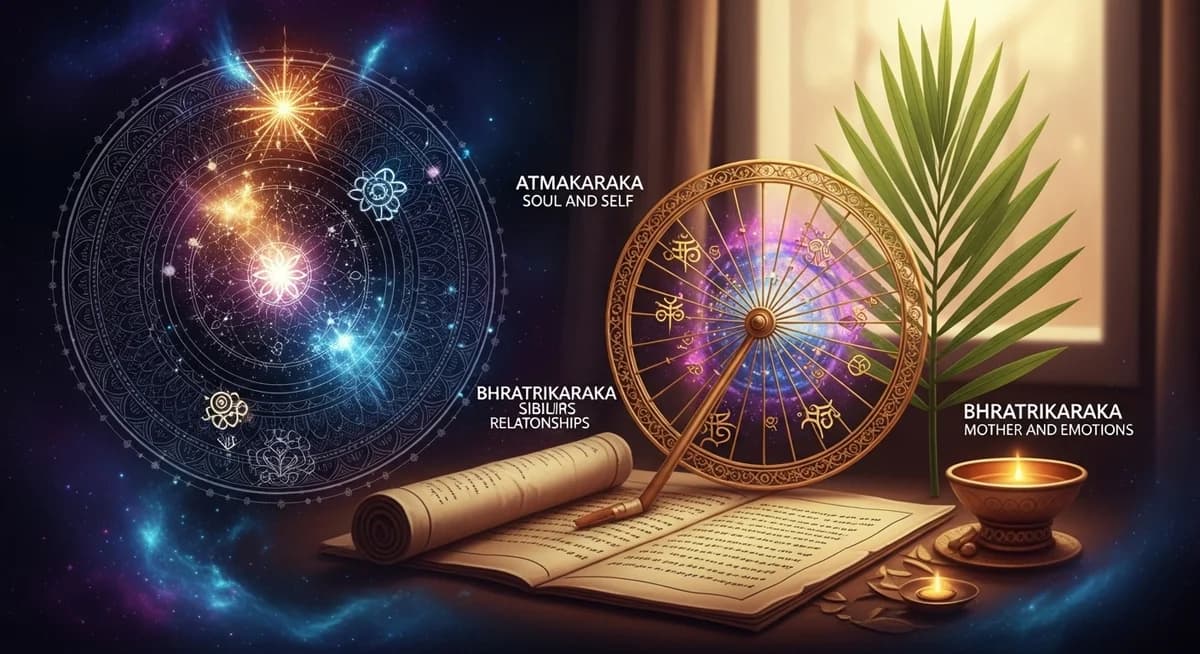
The sequence of charakarakas delineates distinct aspects of the psyche, with each occupying a unique role. Atmakaraka reveals the fundamental essence of one's existence; Amatyakaraka outlines vocational endeavors and purposeful drives; Bhratrikaraka pertains to sibling dynamics and efforts; Matrikaraka is associated with nourishment and maternal principles; Putrakaraka signifies creativity, offspring, and future initiatives; Gnatikaraka indicates challenges and competition; while Darakaraka reflects partnerships and relational dynamics. This clarity flourishes optimally when the degree order remains respected.
Atmakaraka is paramount as it unveils the central stress point of one's life journey. For instance, a Shani Atmakaraka seeks growth through resilience and disciplined patience; a Shukra Atmakaraka strives for refinement through relationships and values; and a Chandra Atmakaraka yearns for stability through emotional depth. Here, the graha does not simply grant a title; it structures the curriculum of life.
Amatyakaraka illustrates how one engages with the external world. A Budha as Amatyakaraka channels energy into communications, trade, and analytical pursuits; conversely, if Mangala holds this position, the path commands courage and leadership. Each sign nuance plays as vital a role as the planet itself, transcending the limits of mythology.
Darakaraka is often oversimplified in mainstream astrology; while it’s frequently termed the 'spouse planet,' this definition is overly reductive. Darakaraka indicates where the soul must navigate the complexities of reflection, compromise, desire, and projection. A Ketu Darakaraka doesn't negate the concept of marriage, but rather challenges the illusions tied to it—a distinction that carries weight in personal relationships.
Upcoming Transits and Activating Charakaraka Doctrine
The astrological environment soon presents a potent learning arena for Jaimini practitioners. Budha transitions into Cancer on June 22, 2026, to then become retrograde on June 30, returning to Gemini by July 7. This pattern is particularly beneficial for discerning charakaraka influences, especially as Mercury governs dialogue, computation, and intellectual articulation. For those with Budha as Amatyakaraka, this period supports revisiting prior decisions and enhancing communication clarity—integral steps in personal growth.
Jupiter's elevation into Poosam nakshatra on June 18 solidifies themes influenced by Guru. However, for individuals with Jupiter posited as Atmakaraka, this period doesn't merely portend good fortune—it demands a maturity of character, family obligations, and elevated emotional conduct. The stakes feel higher, yet so do the opportunities for genuine wisdom.
As Mars shifts from Aries into Taurus on June 20, the ongoing influence of its moolatrikona position becomes clear. For charts where Mars is Bhratrikaraka or Amatyakaraka, this transition shifts energy from decisive action to committed construction. While this may present as a slower rhythm, it heralds sustainable progress.
Rahu entering Avittam on June 28, alongside Ketu remaining in Leo, creates a significant axis. Here, Rahu's magnification of desire clashes with Ketu's stripping of false identities. For those whose Atmakaraka or Darakaraka resides in Leo, Aquarius, Taurus, or Scorpio, this karmic reflection demands radical honesty in self-examination.
Rashi-by-Rashi Effects for Charakaraka Planets
Aries: Jupiter's placement in Cancer stimulates your fourth house, prompting introspection on themes of home, education, maternal influence, and emotional security. Mercury's entry into Cancer on June 22 further emphasizes these themes, enriching communication and decision-making with emotional depth. If Mars stands as your Atmakaraka, its movement from Aries into Taurus illustrates a transition from dynamic action to grounded manifestation, drawing forth a sustainable expression of your goals.
Admin
The AstroKund Editorial Team is led by experienced Vedic astrologers and Jyotish scholars. We combine high-precision mathematical astronomy with the scriptural wisdom of classical texts like Brihat Parashara Hora Shastra to deliver clear, actionable planetary guidance.
Next in Journal
Explore related wisdom

Hartalika Teej 2026: Virgo Moon, Jupiter, and Vow Power
Hartalika Teej on September 13, 2026, embodies a unique spiritual energy with an emphasis on the Virgo Moon, exalted Jupiter in Cancer, and the discipline of Saturn. This day encourages profound devotion and commitment in relationships.

Moksha Yoga in 2026: Saturn, Jupiter, and Liberation
Moksha Yoga sharpens in 2026 through Pisces, Cancer, and Virgo transits. See how Saturn’s retrograde, Jupiter’s exaltation, and lunar movement refine spiritual release.

7th House Marriage Compatibility: Transit Signs for 2026
The 7th house reveals how two people negotiate, cooperate, and endure pressure. August and September 2026 bring real tests and significant opportunities for enhancing marriage compatibility.