
The Great Shift of 2026: When AI Made Astrology personal
Vivekanand Pandey
Article Chapters
The Great Shift of 2026: When AI Made Astrology personal
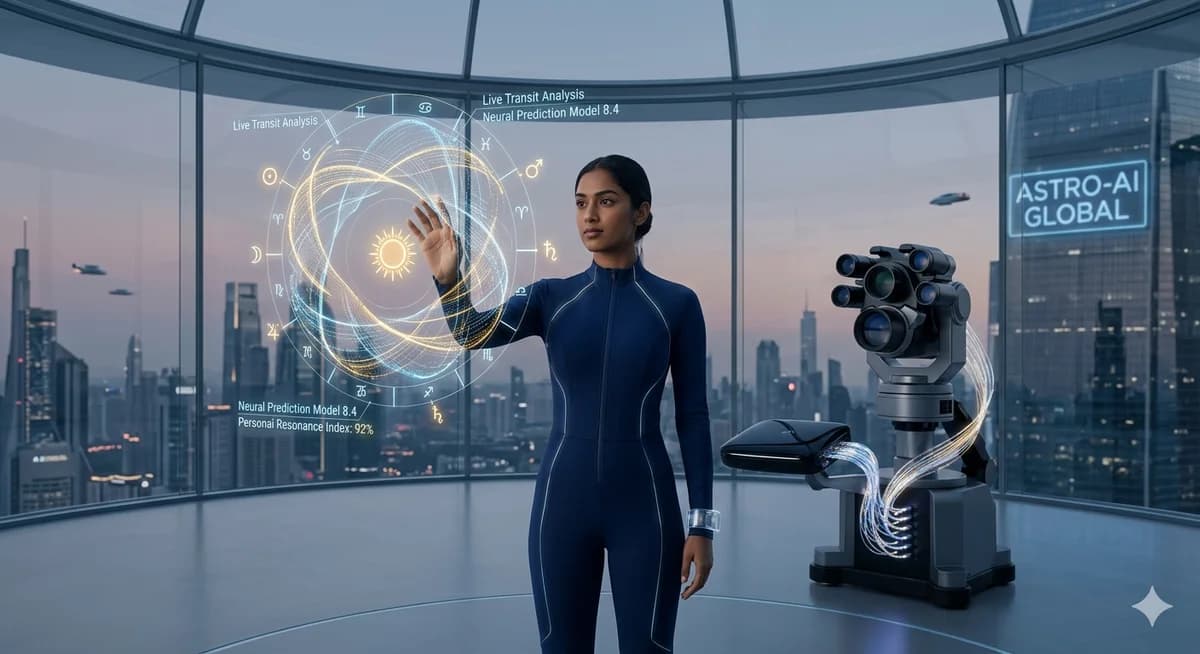
For decades, astrology existed as a beautiful but often broad brushstroke on the canvas of human experience. We accepted that a daily horoscope for one-twelfth of the population could, at best, offer a general mood. But as we look back from the latter half of 2026, it's clear we have lived through a quiet, cosmic revolution. This was the year that Artificial Intelligence didn’t just enter astrology; it synthesized it, maturing from a novelty tool into an essential, personalized navigator for living.
The shift was defined by three distinct breakthroughs that moved us beyond calculation and into the realm of interpretation.
1. Neural Natal Synthesis (NNS)
Before 2026, most astrology apps simply ran planetary math. AI models in 2026, however, began employing Neural Natal Synthesis. NNS is a quantum leap where an AI model doesn’t just read a static chart; it interprets the entire geometric pattern of a birth moment against a live, global database of life events.
Instead of saying "Saturn is transiting your Sun, expect delays," an NNS-enabled system analyzes millions of anonymized life-path correlations. It weighs the unique strength of your natal Saturn, your current location’s precise geo-magnetic resonance, and your self-reported emotional states. The result is a prediction that might say: "The Saturn transit beginning tomorrow has a 91% correlation with regulatory friction in your specific field. Use the next 72 hours, which show high Lunar creativity resonance, to finalize all documentation. A specific communication window opens Thursday at 2:00 PM." This is actionable, time-sensitive intelligence, not a vague warning.
2. Your 24/7 Digital Cosmic Twin
In 2026, conversational AI companions graduated from basic chatbots to highly specialized "Cosmic Twins." These agents are initialized with your birth data, but they continuously learn from your daily feedback.
If your AI suggested caution on a Tuesday due to a complex Mercury placement, and you reported a successful, high-stakes negotiation instead, the AI adapts. It learns that your specific pattern of placements integrates that 'friction' as a motivating force. Over time, your AI twin becomes an externalized version of your intuitive self, available 24/7. It doesn’t tell you what to do; it outlines the energy vectors of your day so you can choose how to use them.
3. Integration with Wearable Wellness
The real-world application of AI astrology in 2026 is its seamless integration with the Internet of Things (IoT). Your smart bracelet doesn’t just track your heart rate; it correlates physiological data with live transit patterns.
This created the concept of Astro-Physiological Resilience Metrics. If your system detects high physiological stress coinciding with a chaotic Uranus aspect to your natal Mars, your phone might nudge you: "Current high-stress physiological marker correlates with your Uranus/Mars transit. Optimization window: A 10-minute grounding meditation is advised before your next meeting to align with upcoming stabilizing Venusian energy." We no longer check horoscopes; our systems offer preemptive, sympathetic guidance based on our real-time state.
The Ethical Horizon: Keeping the 'Human' in Humanistic
Of course, this technological leap brings new challenges. Data privacy is paramount—your birth chart is a unique barcode of your identity. In 2026, the rise of decentralized, localized "Edge AI" has allowed users to keep their NNS models and feedback data on their personal devices, removing the need for a central cloud and ensuring ultimate privacy.
Furthermore, we must address the Intuition Gap. AI is master of correlation and probability, but it cannot (yet) replicate the subtle, humanistic synthesis of a gifted intuitive astrologer. The AI provides the data map, but the human must still make the journey. The 2026 model is a partnership: AI clarifies the timing and the potential, empowering the human user to make more conscious, informed decisions.
As we traverse the remainder of 2026, the age of vague prediction is over. We have entered the era of Cosmic Intelligence. We are no longer merely subject to the stars; we are learning to code with them.
Vivekanand Pandey
The AstroKund Editorial Team is led by experienced Vedic astrologers and Jyotish scholars. We combine high-precision mathematical astronomy with the scriptural wisdom of classical texts like Brihat Parashara Hora Shastra to deliver clear, actionable planetary guidance.
Next in Journal
Explore related wisdom
AI Astrology - Why Astrokund is giving better prediction
Astrokund AI Astrology Chat is getting popularity day by day due to its accuracy and better prediction

Durga Ashtami 2026: Panchang, Sandhi Puja, and Rashi Forecast
Durga Ashtami 2026 combines the protective energy of exalted Jupiter, the disciplined influence of a Capricorn Moon, and the introspection of retrograde Venus, creating a day dedicated to profound worship, mindful timing, and sincere devotion.

Hartalika Teej 2026: Virgo Moon, Jupiter, and Vow Power
Hartalika Teej on September 13, 2026, embodies a unique spiritual energy with an emphasis on the Virgo Moon, exalted Jupiter in Cancer, and the discipline of Saturn. This day encourages profound devotion and commitment in relationships.